Sure of something this new year.

What are you sure of this year? My good friend Chris Nye preached on “God and the Great Unknown” yesterday at WCC (audio forthcoming), where the saints gathered to bring in the New Year with a healthy dose of the Gospel. Certainty is an allusion, one we all cling to, especially when it comes to the circumstances of our lives. Yet even as we live in “uncertain economic times,” we shall pray to God for courage and boldness, and not just for clarity and confirmation (Acts 4:13-20, 29-31). God’s presence is the one thing I am sure of this year.

Should we even make New Year’s Resolutions in these un-sure times? I think so; more to the point, we shall pursue change this year. More on that later this week. There is one thing we Christians must all resolve to do, but before I get to that, let’s consider how the substance and shape of our resolutions have changed over the decades.

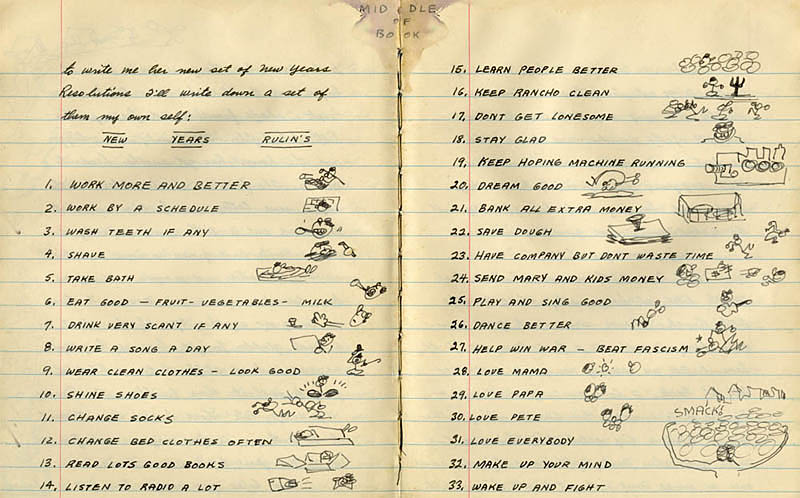
The late Woody Guthrie (songwriter, folk music legend, famous for “This Land is Our Land”) sketched out his “NEW YEAR’S RULIN’S” as 1941 drew to a close and his thirtieth year began in 1942. Here’s a glimpse at his list:

1. WORK MORE AND BETTER
2. WORK BY A SCHEDULE
3. WASH TEETH IF ANY
4. SHAVE
5. TAKE BATH
6. EAT GOOD – FRUIT – VEGETABLES – MILK
7. DRINK VERY SCANT IF ANY
8. WRITE A SONG A DAY
9. WEAR CLEAN CLOTHES – LOOK GOOD
10. SHINE SHOES
11. CHANGE SOCKS
12. CHANGE BED CLOTHES OFTEN
13. READ LOTS GOOD BOOKS
14. LISTEN TO RADIO A LOT
15. LEARN PEOPLE BETTER
16. KEEP RANCHO CLEAN
17. DON’T GET LONESOME
18. STAY GLAD
19. KEEP HOPING MACHINE RUNNING
20. DREAM GOOD
21. BANK ALL EXTRA MONEY
22. SAVE DOUGH
23. HAVE COMPANY BUT DON’T WASTE TIME
24. SEND MARY AND KIDS MONEY (his wife and kids did not travel with him; sadly they divorced in ’43)
25. PLAY AND SING GOOD
26. DANCE BETTER
27. HELP WIN WAR – BEAT FASCISM
28. LOVE MAMA
29. LOVE PAPA
30. LOVE PETE
31. LOVE EVERYBODY
32. MAKE UP YOUR MIND
33. WAKE UP AND FIGHT

[via Lists of Note; Image: The Woody Guthrie Foundation; Large version here]

Do you have any resolutions like those? Are you “keeping [your] hoping machine running?”

While that list is kinda fun, here’s one resolution, a goal even, that shall be our great passion in 2012:

“It ought to be the primary goal of every Christian to put aside confidence in works and grow stronger in the belief that we are saved by faith alone. Through this faith the Christian should increase in knowledge not of works but of Christ Jesus and the benefits of his death and resurrection.”

—Martin Luther, The Freedom of the Christian (Minneapolis, 2008), page 55. [Via Ray Ortlund]


Everything that is coming to us.

“Everything that is coming to us from God comes through Christ Jesus. Christ Jesus has won our pardon; he has reconciled us to God; he has canceled our sin; he has secured the gift of the Spirit for us; he has granted eternal life to us and promises us the life of the consummation; he has made us children of the new covenant; his righteousness has been accounted as ours; he has risen from the dead, and all of God’s sovereignty is mediated through him and directed to our good and to God’s glory.”
—D. A. Carson, A Call to Spiritual Reformation (Grand Rapids, Mi.: Baker Book House, 1992), 189.


Honest.

Quote

Here’s to more authenticity in the new year; for being humble and honest online, as well as in person. We can only be as successful in life as we are honest. And our power comes in the form of a confident humility. We no longer have to try to be the Hero of our own stories. Put Someone Else at the center.

“Facebook is where you lie to your friends. Twitter is where you tell the truth to strangers.” —unknown


Text & Truth: can we trust the New Testament?

A book review of Revisiting the Corruption of the New Testament (Daniel Wallace, series editor).

Last week our son turned five, and simply judging by the gifts received, one would have to conclude the kid loves pirates, LEGO blocks, Star Wars and books. All of this is true; Dutch loves all things related to Yoda, pirates, and LEGO blocks. Further, multiplying the various interests together heightens his enjoyment of the subjects. A LEGO Star Wars set, a pirates books, and even a LEGO Star Wars book. If Dutch has heard a story before, you better not skip a single word as you read it to him the next time. He’ll make you back up the truck and re-read it.

Even for this young kid, precision and accuracy on words really matter. Especially on the subjects that really matter in life.

Same is true in Christian scholarship. Sadly, Christians of the conservative, Evangelical tribe have a poor reputation when it comes to precision and accuracy. Or, what I like to call care and thoughtfulness. Typical modern Christian are not known in broader culture for thoughtful engagement of life issues, for we can talk past one another a lot and embody more of a bumper-sticker theology than a humble orthodoxy and persuasive embodiment of truth. While we’re known for enthusiasm, it can seem a lot like rabble-rousing to some. Of course, you cannot please everyone, but being authentic goes a long way toward gaining credibility and a listening ear.

That’s why I get amped up when I see new books that are worth reading. Whether it’s the latest Tim Keller best-seller reaching the reading masses with solid theology, or some of the passionate and thoughtful. I find a renewed trend in “Christian” being much more than an adjective tossed to the front of religious products seeking a market. Really good Christian books are being published these days, so there’s becoming very little excuse for us not reading sound words that enrich the mind and awaken the soul. (Disclaimer: the book I am reviewing below has a considerable academic bent, and won’t appeal to everyone. That’s okay; sometimes it’s helpful to know that somebody is doing deep thinking and heavy mental lifting, and the contribution of this book will only help the tide of good scholarship flood the shores of culture.)

It’s a common notion that scholarly work lacks excitement, like how documentaries lack a plotline. Yet, that’s not entirely true, as evidenced not only by new persuasive documentaries like “Waiting for ‘Superman’,” as well as in the field of biblical scholarship. While all ‘new’ discoveries are actually ancient ones, there always is a story within the story. The particular field of textual criticism — finding, exploring and examining the real biblical text — is chalk full of twists and turns. How did monks and others preserve the New Testament text so well, even under persecution and adverse conditions? The story of how we got our Bible is only trumped by the crazy-awesome Story the Scripture unfolds itself. Continue reading


[in]complete love: the ruts where we get stuck.

“I will heal their backsliding.”
—Hosea 14:4

I talk with backsliders all the time. Most don’t notice their rut or direction, and almost as many don’t really care. It usually their closest loved ones who seek out a pastor for advice and encouragement.

I also find that when people strongly desire change (circumstantially), but are not willing to change themselves, they are in the throngs of many dangers. At least one of those is how we creatively find ways to meet our heart longings in ways that can slowly (or quickly) destroy us. Our poor decision-making accumulates over time, for very few people wake up one day and say “I want to run from God and make a mess of my life.” Little by little we get stuck in a rut of our own choosing, not recognizing the warning signs, and sometimes ignoring them. When confronted by loved ones, we minimize, deny, deflect, distract or minimize our issues, numbing the pain while making it worse.

Consider the analogy of a muddy road:

God’s people let themselves drift. We fall into backsliding gradually, a process unfolding over time. This is no surprise, for apart from the grace of God we remain children of Adam our entire lives. We can never shake off our old nature completely; it clings to us with the tendrils of countless sinful tendencies.

The life of God’s child is illustrated in a frequent scene in rural Michigan [or Central Oregon, where I grew up] during the winter weeks of heavy snow. The lanes and smaller roads, many of them unpaved, become muddy and nearly impassable. Looking down these after a snow, at first only one set of tracks appears. As each subsequent vehicle follows the same tracks, the ruts grow increasingly deeper, until someone finally becomes stuck and can go no further.

Similarly, God’s children are prone to follow the tracks of their muddy human nature, following those tracks wherever they lead. The further they go, the deeper they sink into the ruts, step by step, one thing leading to another until they get stuck. What are these ruts believers are so inclined to fall into? I can enumerate at least these six:

  1. Coldness in prayer
  2. Indifference under the Word
  3. Growing inner corruptions
  4. The love of the world
  5. Declining love for believers
  6. Man-centered hopes

—Joel R. Beeke, Getting Back in the Race: the cure for backsliding

Backsliding is always an issue of love. Our heart longs for something, usually a legitimate need, yet we somehow invent illegitimate ways to meet those needs. (Such as when a teenage girl desires affection from her father but goes with a vastly incomplete substitute: a boyfriend.) When we’re bored with God and His good will for us, we seek out alternative routes to travel. Killing sin isn’t about never getting in a rut; it’s about finding the desire to run to God, and seek help, when we get stuck.

For more on backsliding see:

Every day I talk to a potential backslider. Myself. (You do too.) Preach the Gospel to yourself each and every day. Teach yourself to love God and His good news.

Image credit: “Bad Road” by National Library of Scotland


The Story behind today.

St. Paul’s Arts ‘n’ Kids tell the story of Christmas (2010). (Presented at GLOW Carols by Glowstick on 12 December 2010 at Vector Arena, Auckland.)

Now consider the implications of The Incarnation, spoken word by Odd Thomas:

“Man’s maker was made man,
that He, Ruler of the stars, might nurse at His mother’s breast;
that the Bread might hunger,
the Fountain thirst,
the Light sleep,
the Way be tired on its journey;
that the Truth might be accused of false witness,
the Teacher be beaten with whips,
the Foundation be suspended on wood;
that Strength might grow weak;
that the Healer might be wounded;
that Life might die.”
—Augustine of Hippo (Sermons 191.1)

Enjoy a special FREE Christmas song, written and sung by Aaron Sternke: “Our God, Here to Save Us

The paradox of Jesus come as the God-Man shows the great creativity of our Creator, and the lengths to which He has gone to bring us back to Himself:

”He was poor, that he might make us rich.
He was born of a virgin that we might be born of God.
He took our flesh, that he might give us His Spirit.
He lay in the manger, that we may lie in paradise.
He came down from heaven, that he might bring us to heaven….

That the ancient of Days should be born.
that he who thunders in the heavens should cry in the cradle….
that he who rules the stars should suck the breast;
that a virgin should conceive;
that Christ should be made of a woman, and of that woman which himself made,
that the branch should bear the vine,
that the mother should be younger than the child she bare,
and the child in the womb bigger than the mother;
that the human nature should not be God, yet one with God

Christ taking flesh is a mystery we shall never fully understand till we come to heaven

If our hearts be not rocks, this love of Christ should affect us.

Behold love that passeth knowledge!”

—Thomas Watson


God With Us: the end of fear. [a reflection on the good news of Christmas]

Willamette lights by Jordan Chesbrough

Have you ever felt afraid? Even in the happiest of times, fear can haunt our hearts, nagging, keeping us from experiencing true joy and peace.

What if I lose my job? Did I get the present I hoped for? Why was my friend acting mean to me? Why wasn’t I invited to the party? Will I make the team? Will I get accepted? Will he always love me? Will we have enough? Will I be healed?

As you read the Christmas story in Luke 1 and 2, you’ll find angels appearing three times, messengers from God sent from heaven to give the world wonderful news about the Savior Jesus Christ. The angels appeared to a man named Zechariah, a girl named Mary, and a group of shepherds in Bethlehem. Each was occasion for celebration, for the angels brought the greatest news the world would ever hear. But do you know what happened each time the good news came?

Those who heard were afraid.

Zechariah was afraid (1:12). Mary was afraid (1:19). The shepherds were afraid (2:9).

And all three times the angels spoke these words:

“Do not be afraid.”

That night there were shepherds staying in the fields nearby, guarding their flocks of sheep. Suddenly, an angel of the Lord appeared among them, and the radiance of the Lord’s glory surrounded them. They were terrified, but the angel reassured them. “Don’t be afraid!” he said. “I bring you good news that will bring great joy to all people. The Savior—yes, the Messiah, the Lord—has been born today in Bethlehem, the city of David! And you will recognize him by this sign: You will find a baby wrapped snugly in strips of cloth, lying in a manger.” —Luke 2:8-12 (NLT)

These heavenly messengers were the first to declare the Message of Christmas — that God so loved us that He gave His only Son, that whoever believes in Him will never die but will have eternal life.

Christ is the end of fear for all who believe. Why? Because Christ conquered the source of fear. He triumphed over sin and death, trampling Satan once and for all, delivering us from evil and delivering us into the God’s glorious Kingdom. But sometimes—just like Zechariah, Mary, and the shepherds—we can actually be afraid of the message of Christ. We can be afraid of really trusting Him. What will He make me do? we wonder. But Christianity isn’t primarily about what God asks us to do but what God has already done.

What has God done? He has loved us.

“This is how God showed His love among us: He sent His one and only Son into the world that we might live through Him…. There is no fear in love, but perfect love drives out fear…” —1 John 4:9, 18 (NIV)

As you welcome Christ in your hearts and home this Christmas His perfect love will cast out all fear. (You know who wasn’t afraid in the story? The angels. Perfect love does cast our fear.)

Look to Him and hear His words, “Do not fear, only believe.” No need to fear; God is with us.

Merry Christmas.

For a Child is born to us, a Son is given to us.
The government will rest on His shoulders.
And He will be called:
Wonderful Counselor, Mighty God,
Everlasting Father, Prince of Peace.
His government and its peace will never end.
He will rule with fairness and justice from the throne of his ancestor David for all eternity.
The passionate commitment of the Lord of Heaven’s Armies will make this happen!

—Isaiah 9:6-7 (NLT)

Reflection questions for discussion:

  • When were you afraid this year? How did you respond when overcome with fear?
  • What are you afraid of today?
  • Is there any aspect of that coming year that makes you feel afraid?
  • How does Christ’s presence remove that fear?
 

Finding the good kind of joy.

Kari wrote a new post for {in}courage, up today: “How Joy Comes to Your World.” She begins:

About a month ago we sold our dream house and down-sized into a rental. We lost a lot of money, I guess you’d say.

We lost about 1,000 square feet. Lost that big soak tub. Lost my walk-in closet. Lost our garage. Lost our double-sinks. I guess we lost the tax deduction for mortgage interest too.  Now that I think about it, I guess we lost a lot.

Maybe that’s why I feel so much lighter. Why I feel so free.

What happened? some asked. Lose your job? Unforeseen financial challenges?

Nope. Nothing’s changed except our hearts. We read a little story about a Kingdom:

The Kingdom of Heaven is like a treasure that a man discovered hidden in a field. In his excitement, he hid it again and sold everything he owned to get enough money to buy the field.

Discovering hidden treasure makes us so excited we do crazy things.

We find crazy joy.

Because that’s what we’ve found in the midst of all this loss. Found this crazy joy of kicking the American dream to the curb and racing back to that field to dig down and unearth that treasure


The Awesome Generation: Millennials [infographic]

Each generation believes they are the best one ever. Yet, as we solve today’s problems we are invariably creating new ones for tomorrow.

I am a young “Gen-Xer,” one of those age 30-45 (born roughly between 1964-1979), and can sometimes find myself chuckling at the cultural differences between our generations. The previous group are the “Boomers,” which of course include my parents as the pioneers, coming as the kids of the “Silent” generation who lived through the two World Wars and the Great Depression. The Boomers, combining ingenuity, hard work, and sheer size as a people group, shaped everything from health care, to the economy to politics and education. Things have come easy to them as they’ve worked so hard, and rode a tide of prosperity our nation has never before seen. The Gen-Xers have been told all our lives we are smart enough, good enough, and that everyone should like us. We’re hopped up on self-esteem and if any generation deserves the label “Awesome,” it would be us, right?

Well, perhaps the next one is more subtly awesome. What are the defining traits of emerging group of adults today — ages 18-29 — the Millennials? As we enter a New Year, how about a look at how the next generation looks at the world and lives in it.

Fast Company Design’s Infographic Of The Day: The Blessing And Curse Of Being A Millennial

Fast Co. Design’s founding editor Cliff Kuang writes:

Millennials are well-educated, tech-savvy, and independent. They’re also cursed by a bad economy. But all this might have a silver lining…

You heard constantly about the millennial generation–that they’re tech-savvy, and different from everyone that came before. It’s not just hype, or vanity on the part of the youngsters: People who are 18-29 right now have markedly different attitudes, beliefs, and mores than any generation preceding them.

This infographic by Online Graduate Programs does a good job of summing up all that data. First, who are the Millennials, and what are their politics?:

Continue reading


Wisdom: How do I protect my kids from consumerism and envy?

As a father or two little ones, and a pastor to a few more, I appreciate Ken’s wisdom and grace as he responds to this urgent question (as a father and pastor):

Ken Wytsma, President of Kilns College and Pastor of Antioch Church in Bend, OR, talks about the effects of American consumerism and envy on children. [via :redux]


Grace and Fullness we have received.

Re-post: originally written 24 Dec 2009 at deTheos.com.

Wonder what Jesus looks like?

We don’t know. One day we shall see Him as He is, and become like Him (1 John 3:2). (Doubt He looks like the blue-eyed, blond-haired version sold here in the States as “Jesus junk,” that is, as trinkets.) Yet, we do have some clues as to what He is like. His character shines through brighter than His physical appearance. He’s full of compassion (Matthew 9:36: σπλαγχνίζομαι = moved with compassion), which is much deeper than mere emotion. More broadly, He’s full of grace and truth. He is the living embodiment of Grace, and Truth became a Person. Grace is meant to be experienced, truth intended to be known in the same way. We are to “receive” them as we receive Him. God’s grace never fails, and as wholly true He is completely faithful. (He’s not like us.)

Yet, He became like us. One of my favorite passages of Scripture is in the Gospel of John, first chapter, verses 14 & 16. It reads:

And the Word became flesh and dwelt among us, and we have seen his glory, glory as of the only Son from the Father, full of grace and truth…. And from his fullness we have all received, grace upon grace.

In His incarnation, Jesus stepped down into our world, showing us the worth of God in real-time. Someone has said the Incarnation is “deity for dummies.” God made Himself obvious and visible. Jesus was overflowing with the two essential qualities of perfect humanity: grace and truth. Those twin perfections remind us of God’s essential character: “steadfast love [Heb. hesed] and faithfulness [Heb. ’emet]” as revealed about 1,500 years prior in Exodus 34:6 (cf. Exodus 33:18–19). Moses asked to see God in all His glory. Yet the great patriarch was only  able to see the back side of God’s presence passing by. Here in Jesus we see God making Himself known as a person. To be known, experienced, treasured and loved. If God is a theory or His Son simply a business transaction to get us to Heaven, we we’ll miss everything in between. This relationship of love is founded on endless grace and rock-solid truth. God intends Jesus to be sufficient for our failures and sweeter than our failures. He is Grace & Truth in action, making life worth enduring until the end. The Triune God enjoys a fullness that spilled over into this world.

A few years back pastor John Piper wrote about these Scriptures and the Incarnation in a short article on these verses (read the entire thing here). Here are some highlights:

  • …the one from whose fullness I am being drenched with grace is the Word that was with God and was God (John 1:1-2), so that his fullness is the fullness of God—a divine fullness, an infinite fullness;
  • …this Word became flesh and so was one of us and was pursuing us with his fullness—it is an accessible fullness;
  • …when this Word appeared in human form, his glory was seen—his is a glorious fullness;
  • …this Word was “the only Son from the Father” so that the divine fullness was being mediated to me not just from God, but through God—God did not send an angel but his only Son to deliver his fullness;
  • …the fullness of the Son is a fullness of grace—I will not drown in this fullness but beblessed in every way by this fullness;
  • …this fullness is not only a fullness of grace but of truth—I am not being graced with truth-ignoring flattery; this grace is rooted in rock-solid reality.

As I savor this illumination of Christ’s fullness, I hear Paul say, “In him the whole fullness of deity dwells bodily” (Colossians 2:9). I hear him say, “In him all the fullness of God was pleased to dwell” (Colossians 1:19). And I hear him say, “In him are hidden all the treasures of wisdom and knowledge” (Colossians 2:3).

Can we see how deeply that God’s glory resides in Jesus? He intends us to seek Him in that one place alone: in Christ. Piper continues:

Paul prays that we would experience Christ’s fullness. Not just know about it, but be filled with it. Here is the way I hear him praying for me:

That I “may have strength to comprehend with all the saints what is the breadth and length and height and depth, and to know the love of Christ that surpasses knowledge, that you may be filled with all the fullness of God” (Ephesians 3:18-19).

The “fullness of God” is experienced, he says, as we are given the “strength to comprehend” the love of Christ in its height and depth and length and breadth—that is, in its fullness. This is remarkable: The fullness of God is the spiritual apprehension (experience) of the fullness of the love of Christ. This love is the grace and truth that fills the Son of God and pours out on us.

Experiencing the fullness this Christmas. Pray you are as well.