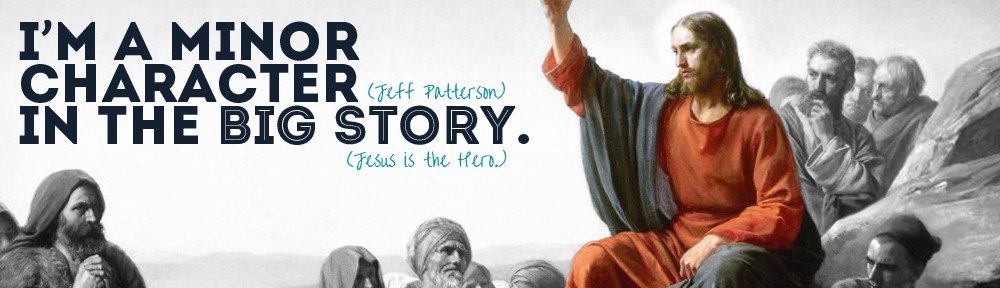
Tim Keller speaking on Jesus [mp3; thanks to Peter Artemenko for creating the kinetic type illustration]:
Jesus is the true and better Adam who passed the test in the garden — His garden, a much tougher garden — and whose obedience is imputed to us.
Jesus is the true and better Abel who, though innocently slain, has blood now that cries out, not for our condemnation, but for acquittal.
Jesus is the true and better Abraham who answered the call of God to leave all the comfortable and familiar and go out into the void not knowing wither he went to create a new people of God.
Jesus is the true and better Isaac who was not just offered up by his father on the mount but was truly sacrificed for us. And when God said to Abraham, “Now I know you love Me because you did not withhold your son, your only son whom you love from Me,” now we can look at God taking his son up the mountain and sacrificing him and say, “Now we know that You love us because you did not withhold your son, your only son, whom you love from us.”
Jesus is the true and better Jacob who wrestled and took the blow of justice we deserved, so we, like Jacob, only receive the wounds of grace to wake us up and discipline us.
Jesus is the true and better Joseph who, at the right hand of the king, forgives those who betrayed and sold him and uses his new power to save them.
Jesus is the true and better Moses who stands in the gap between the people and the Lord and who mediates a New Covenant.
Jesus is the true and better Rock of Moses who, struck with the rod of God’s justice, now gives us water in the desert.
Jesus is the true and better Job, the truly innocent sufferer, who then intercedes for and saves his stupid friends.
Jesus is the true and better David whose victory becomes his people’s victory, though they never lifted a stone to accomplish it themselves.
Jesus is the true and better Esther who didn’t just risk losing an earthly palace but lost the ultimate and heavenly one, who didn’t just risk his life, but gave his life to save his people. Who didn’t just say, “If I perish, I perish,” He said, “When I perish, I’ll perish for them, to save My people.”
Jesus is the true and better Jonah who was cast out into the storm so that we could be brought in.
Jesus is the real Rock of Moses, the real Passover Lamb, innocent, perfect, helpless, slain so the angel of death will pass over us. He’s the true temple, the true prophet, the true priest, the true king, the true sacrifice, the true lamb, the true light, the true bread.
The Bible’s really not about you—it’s about Him.


 Surely, the benefits of participation [in social media & networks] are well-documented, but there are costs, too. While information is being channeled through these social networks, the fact remains the same illusions created by television have mutated into a stronger strain within social media. While more interesting information gets to us faster, the downside is that the new channels—and, we are all the channels—sometimes unknowingly create “little white illusions” that, over time, compound into something that may or may not reflect real life.
 “The bigger and more biblical your understanding of who Jesus is, the more likely he is to be such an object of love and adoration that the idols that aim at capturing your attention and swaying your allegiance will lose their power. This is why you sometimes lack earnestness for the kingdom and the glory of God while you overflow with passion concerning temporal things. Instead of making a joyful noise and singing earnestly for the victory Christ has over sin and death, you express a dispassionate approval and mouth the words to the songs sung in worship. But there is often fire in your belly and shouts of joy when your favorite college football team is victorious over the competition. This is probably why the church is shrinking in North America—because small Jesus does not inspire awe, command respond, lead to worship, or compel us to talk of him (much less suffer for him). And small Jesus is too little to arrest the attention of the world.


 “Many people possess virtues — such as humility, patience, charity towards their neighbors, and so on—but only as a matter of rational choice and directed will, having no love or spiritual delight in them. Such a person will perform virtuously, but often with grouching, heaviness, or even bitterness in the doing. Nevertheless, perform he does, prompted rationally out of a fear of God.